I can see why everybody raves about Duolingo. It's an absolutely wonderful app! It makes learning languages fun, so much so that I actually look forward to my daily Gàidhlig lesson.
I have decided to record my recent progress here. One thing I'm concerned about, is that whilst I'm full of enthusiasm right now, it may wane with time, especially when I start to get bogged down with the grammar. However, if I can make sense of what I'm learning as I go along, then I'm hoping I will maintain my motivation.
These notes have been written for me, however I think I may as well share them with the world. I'm learning, however, and I may well make mistakes, so please don't rely on them.
The Gaelic Alphabet
A wee rhyme I have made up for me to remember the letters: There's no j, or k, or q, or anything after u.
Summarised from Daily Gaelic on YouTube: https://www.youtube.com/watch?v=hLVOL0c99sk
- Contains just 18 letters.
- It misses (from the Roman alphabet): J, K, Q, V, W, X, Y & Z.
- Vowels: A, E, I, O & U.
- Broad vowels: A, O & U.
- Slender vowels: I & E
- C's and G's are 'hard' in Gaelic, i.e. like a 'K'.
- Emphasis is usually placed on the first syllable, unless the second syllable is accented.
- Graves, or accents, make the vowel sound longer.
- The only letters that can appear in pairs together are: L, N & R.
e.g. letter D
[Nb: most consonants don't have four different sounds, the broad and slender may sound the same].
Strachan are very important in Gaelic. For example, ‘bas’ — without a stràc on the ‘a’ — means the the part on the inside of your hand between the fingers and the wrist, or ‘palm’ in English. But ‘bàs’ — with a stràc on the ‘a’ — means the end of life, or ‘death’ in English. That's a pretty big difference!
My notes from the pronunciation videos on the Learn Gaelic website.
I - is often pronounced 'ee' - e.g. ím (eem); iasg (ee-asg); isean (eeshan); mi (mee)
Lenition on verbs
- striggered by the negative particle cha(n)
- triggered by the negative interrogative/subordinating particle nach
- triggered by past tense particles (do/null)/(do) dh’
- triggered by the relative particle a
- triggered by some forms of the definite article an/a’
- triggered by some possessive agreement markers
- triggered by some prepositions:
- bho- gu- do- anns a'- air- aig
- triggered by the numerals aon ‘one’ and dhà ‘two’
- realises some number/case inflection on nouns
- words beginning with labials and velars in the masculine genitive after the article (after a' -- and an if before f) (also s --> t-s)
- words beginning with labials and velars in the masculine dative after the article (after a' -- and an if before f) (also s--> t-s)
- words beginning with labials and velars in the feminine common case after the article (after a' and an/__f) (also s --> t-s) - obligatory on right-hand member of some compounds
- triggered by some derivational prefixes
Lenition on adjectives
- triggered by intensifiers glè ‘very’, ro ‘too’, and fior ‘truly’
- realises gender/number/case inflection on adjectives.after feminine nouns
- after dative masculine nouns
GRAMMAR
[Nb: again I emphasise that I am learning Gaelic. These are simply my notes and should never be relied upon! I am simply creating them as and when required, which is essentially when they appear on Duolingo.]
Duolingo doesn't explicitly teach grammar, at least not yet. However, one intuitively learns the sentence structure. Sentences begin with the verb.
e.g. Tha ceic math, literally 'is cake good'; though this is not a question, but a statement, i.e. 'a cake is good'.
Also the noun appears to precede the adjective, e.g. caileag bheag, literally 'girl small'.
Finally, the adjective has to agree with the noun's gender:
e.g. 2 fem. maddain bhlath (lit. 'morning warm')
Determining a noun's gender
I don't want to have to learn the gender of every noun, so a quick internet search elicited the following blog post, which I'm hoping will help:
https://blogs.ed.ac.uk/garg/2020/04/17/predicting-grammatical-gender-in-scottish-gaelic-with-machine-learning/
The author posts a list from a book published in 1923:
Masculine: -adh, -an/ean, as, ach, -aiche & -air.
Feminine: -ag, -achd/-eachd, -ad, /-ead, -e and -ir (for polysyllables only).
Jason, who produces the highly regarded YouTube channel Gaelic with Jason, has the following list for feminine nouns (click to enlarge):
The video is entitled How to Spot a Feminine Noun.

Column 2 - female nouns typically end in: -ag, -achd & -id.
Column 3 - female humans and animals, which are always feminine nouns, e.g. bò.
Column 4 - countries and languages are typically feminine, eg. gàidhlig.
Column 5 - the final vowel is 'i' or 'e', which are known as 'slender vowels'.
Lenition
Lenition essentially means adding an 'h' after the first letter of the adjective, which changes the sound of the word, e.g. math (mah) & mhath (vah). Lenition doesn't apply to 'L', 'N' & 'R' (Non-Lenitable Rabble).
Lenition appears to apply to adjectives describing female nouns, only.
Adjectives only lenite when they are the attribute to a noun. That's the type of sentence where you say something like "Calum has a silly sheep" - Tha caora ghòrach aig Calum.
Adjectives do not lenite when they are in predicate position, that's the type of sentence where you say "The sheep is silly" - Tha a' chaora gòrach.
Sentence Structure
Typically, Gaelic sentences are formed of:
Verb - Subject - Everything else [adverbs follow the adjectives they're describing]
e.g. 1 - 'Tha sinn a' cluiche geama' (we are playing a game)
THE VERB 'TO BE' - BI
Bi is the singular imperative form, e.g. Bi faiceallach mus tuit thu! - 'be careful before you fall!', but is the headword used in dictionaries; it is one of the ten Irregular Verbs in Gaelic, so may cause confusion.
PRESENT TENSE
Tha is the present tense, independent form of the verb:

e.g. 2 - Chan eil peata aig Anna - Anna does not have a pet.

e.g. 3 - Cha robh mi sgíth - I was not tired.

PERSONAL PRONOUNS


Mise / Tusa / Sinne/ Sibhse
These words are used for emphasis or clarification:
Mise: This means 'I' or 'me', e.g. 'Is mise Iain.' (I am Ian.)Tusa: This means 'you' (singular), e.g. 'Tusa a rinn e.' (You did it.)
Sibhse: This means 'you' (plural), e.g. 'Sibhse a thàinig an seo.' (You all came here.)
'Is mise Seumas.' - (Is misha Seumas - I am James.)
Key Differences:
Context and Emphasis: 'Tha mi' is used for general statements about one's current state or location.
'Is mise' is used to emphasise who you are, especially in introductions or when clarifying identity. Structure:
* 'Is mise' follows the structure of "copula + emphatic pronoun" and is used with nouns to make a strong, clear statement about identity.
* Identifying Oneself:"Is mise an tidsear ùr." - "I am the new teacher." This identifies your role or who you are with emphasis.
The preposition 'á'
Is used to state someone is from (or not from) a particular place. This is often used in response to the question, 'Cò às a tha thu?' - Where are you from?
When a place name has a definite article in front of it, use às instead of à.
This activates the dative:
e.g. 2 Tha mi às an Òban. - I am from Oban.
e.g. 3 Tha mi às na Hearadh. - I am from Harris.
Orm & Ort
- Orm - on me, e.g. 'Tha seacaid orm a-nis.' (ha shak-adge oram a-niss - I have a jacket on now)
- Ort - on you, e.g.
- nominative - the 'normal' case.
- vocative - used when addressing someone.
- genitive - used to indicate possession.
- dative - used when governed by prepositions.
- Add "a": Put an "a" before the name when calling someone.
- Lenite the name, if lenitable.
- Gaelic drops the 'a' for vocative when the next syllable is a vowel.
Cia mheud? - How many?
A common alternative to cia mheud is cò mheud, which means the same thing.
Unlike in English, Gaelic uses the singular form of the noun:
bàta - boat
bàtaichean - boats
Cia mheud bàta? - literally 'How many boat?'
The definitive article in Gaelic changes according to a noun's gender, case and the number of the noun it defines. Gender is simply a way of classifying nouns which indicates how it behaves in a sentence, nothing more - it's either masculine or feminine.
The basic form of the article is 'an'.
an is used before words beginning with:
- consonants - except: b, c, g, m & p; sn, sl, sr & s + vowel
- a vowel.
- 'f' and followed by a vowel (these words are lenited - it appears that the 'fh' is silent).
- 's' with the exception of those that are followed by a vowel and the Non-Lenitable Rebels (n, l & r).
- If one considers an to be the basic form, then only the rules for a' and an t- need to be learned, as by default anything else is an.
- a' is used before words beginning with: b, c, g, m & p. These are lenited.
- an t- is used before: sn, sl, sr & s + vowel
- an is used before masculine words beginning with: c, g, s, t, d, l, n, & r.
- am is used before masculine words beginning with: b, f, m & p [! Nb - these are all bilabials]
- an t- is used before masculine words beginning with: a vowel (a, e, i, o & u)
- There are, apparently, very few Gaelic words beginning with 'h', so no specific rule
Plural Nouns:
- Na is used before plural nouns beginning with a consonant, e.g. Na bàtaichean.
- Na h- is used before plural nouns beginning with a vowel, e.g. Na h-orainsearan.
- Am bu toil leat/leibh...? - Would you like...?
- An toil leat/leibh...? - Do you like...?
- Nach robh...? - Wasn't there?
Ann an vs anns an
Anns is a definite noun. Ann an is used when not using the definite article; 'in (a)' - Ann an/Ann am = ine.g. 1 - anns an taigh = in the house
e.g. 2 - ann an taigh = in a house
THE DATIVE CASE
Best described as the Prepositional Case. However, the Dative Case does not really apply following non-definite prepositions, though some nouns lenite following a preposition, especially the ones ending in 'o', e.g. ro, tro and bho.e.g. 2 - Aig banca - at a bank.
e.g. 3 - Còmhla ri caraid - with a friend.
e.g. 4 - Air bòrd - on a table.
- an is used before words beginning with:
- consonants - except: b, c, g, m & p; sn, sl, sr & s + vowel
- a vowel.
- 'f' and followed by a vowel (these words are lenited - it appears that the 'fh' is silent).
- 's' with the exception of those that are followed by a vowel and the Non-Lenitable Rebels (n, l & r)
- a' is used before words beginning with: b, c, g, m & p. These are lenited.
- an t- is used before: sn, sl, sr & s + vowel
So, essentially masculine definite articles become 'female', as in the nominative case:
e.g. 2 - am bórd mor > a' bhórd mhór [i.e. am becomes a' & is lenited]
Strictly speaking, feminine nouns should be slenderised (an extra i added) in the dative case.
Consider bòrd:- bòrd - a table
- am bòrd - the table
- air bòrd - at a table [no article, therefore noun does not change in any way]
- air a' bhòrd - article, so now the dative rules apply; the definite article 'am' reduces an to a', and the moun lenites (just like feminine nouns [in nominative] with an article).
above of the mountain - thar na beinne
Pretty much all of those genitive ones can have an "of" in the translation]
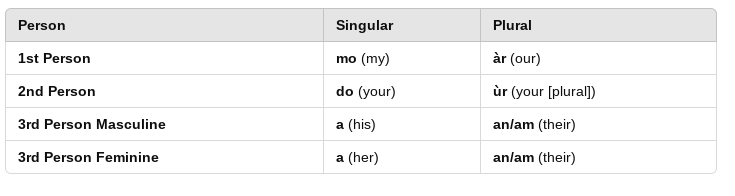
Possession in Gaelic
e.g. 2. - do cheann - your head
Nb. when used with vowels, the possessive pronouns are contracted, e.g. d' athair - your father.
Adjectives which precede the noun
As a rule, adjectives come after the noun. However, there are some exceptions, these cause lenition:
Droch (droh-kch) - bad
Le and Leis
- Use "le" when followed by a name, a regular noun, or a vowel sound.
- Use "leis" when followed by the definite article ("an/am"), a pronoun, or for smoother pronunciation.
List of Gaelic Resources:
Acair Books - https://acairbooks.com/
BBC Gaelic Revision - https://www.bbc.co.uk/bitesize/subjects/zqnygk7
Beag air Bheag - https://www.bbc.co.uk/alba/foghlam/beag_air_bheag/
Ceolas - https://www.ceolas.co.uk/
Ceumannan - https://storlann.co.uk/ceumannan/
Cleachdi - https://www.cleachdi.scot/ [very useful for finding Gaelic events]
Daily Gaelic - https://daily-gaelic-school.thinkific.com/
Duolingo (history of courses) - https://duolingodata.com
e-sgoil - https://www.e-sgoil.com/gaidhlig/
Fandom Gaelic - https://duonotes.fandom.com/wiki/Scottish_Gaelic
Gaelic forum - https://www.foramnagaidhlig.net/
Gaelic Grammar Wiki - https://gaelicgrammar.org/
Gaelic Run (Grammar game) - https://gaelicrun.gordonmaloney.info/play
Gaelic suffixes - https://en.wiktionary.org/wiki/Category:Scottish_Gaelic_suffixes
Gaelic with Jason - https://www.youtube.com/c/GaelicwithJason
Google in Gaelic - https://www.google.com/webhp?hl=gd
Guide to verb 'to be' - https://www.celtic-languages.org/Guide_to_Scottish_Gaelic_to_be,_the_linking_verbs:_substantive_bi,_tha_%26_the_copula_is
Guide to pronunciation - https://en.wiktionary.org/wiki/Appendix:Scottish_Gaelic_pronunciation
Learn Gaelic's Grammar Hacks - https://learngaelic.scot/grammar_hacks/
Love Gaelic - https://www.lovegaelic.com/
Slighe - https://www.slighe.org/
The Grammar of Scottish Gaelic - https://lingsocmonash.wordpress.com/2018/04/06/the-grammar-of-scottish-gaelic-part-2/
Notes for future use:
aig is used to express possession (what you have, whether or not you own it)le is used to express ownership (whether or not you currently have it)
2) Yes, LE translates as "with" but note that in Scottish Gaelic, it's only used for ownership, rather than simply "having". For anyone who knows Irish or Welsh, note the difference in that Irish LE and Welsh GYDA (both "with") are used for "having" with no implication of ownership.


No comments:
Post a Comment